 EN
 DE


Keeping a cool head to make the right decision
The heating transition is a key issue for buildings, neighbourhoods and businesses. However, as summer temperatures rise, another challenge is becoming increasingly important: buildings must not only be reliably heated in winter, but also effectively cooled in summer.
Prolonged heatwaves pose particular challenges for older existing buildings with poor insulation. At the same time, large window areas in modern new-builds can lead to high levels of solar heat gain. This affects comfort, the use of living spaces and the ability to concentrate in office buildings.
A sustainable solution should not treat heating and cooling as separate issues. Heat pumps can also be used for temperature control in reversible mode, provided the building and the heat distribution system are suitable for this. When combined with geothermal energy, this opens up further possibilities for particularly efficient cooling.
@M&P Energy - Part of @SIERA – supports the planning of heating and cooling systems, taking into account buildings, energy sources and long-term operating conditions.
Why portable coolers often reach their limits
Mobile units with evaporative cooling or monoblock air-conditioning units can provide temporary relief. During prolonged heatwaves, however, they often reach their performance limits. Furthermore, they consume a great deal of electricity and can increase running costs if used continuously.
Split air-conditioning systems often achieve greater efficiency. However, they are frequently used as single-room solutions and may require additional structural work. Furthermore, depending on their location, outdoor units can affect the appearance of a building and may be perceived as a source of noise.
For buildings with a central heating system, it may be worth checking at an early stage whether the existing or planned heat pump can also be used for space heating.
Reversible operation: heat pumps can also cool
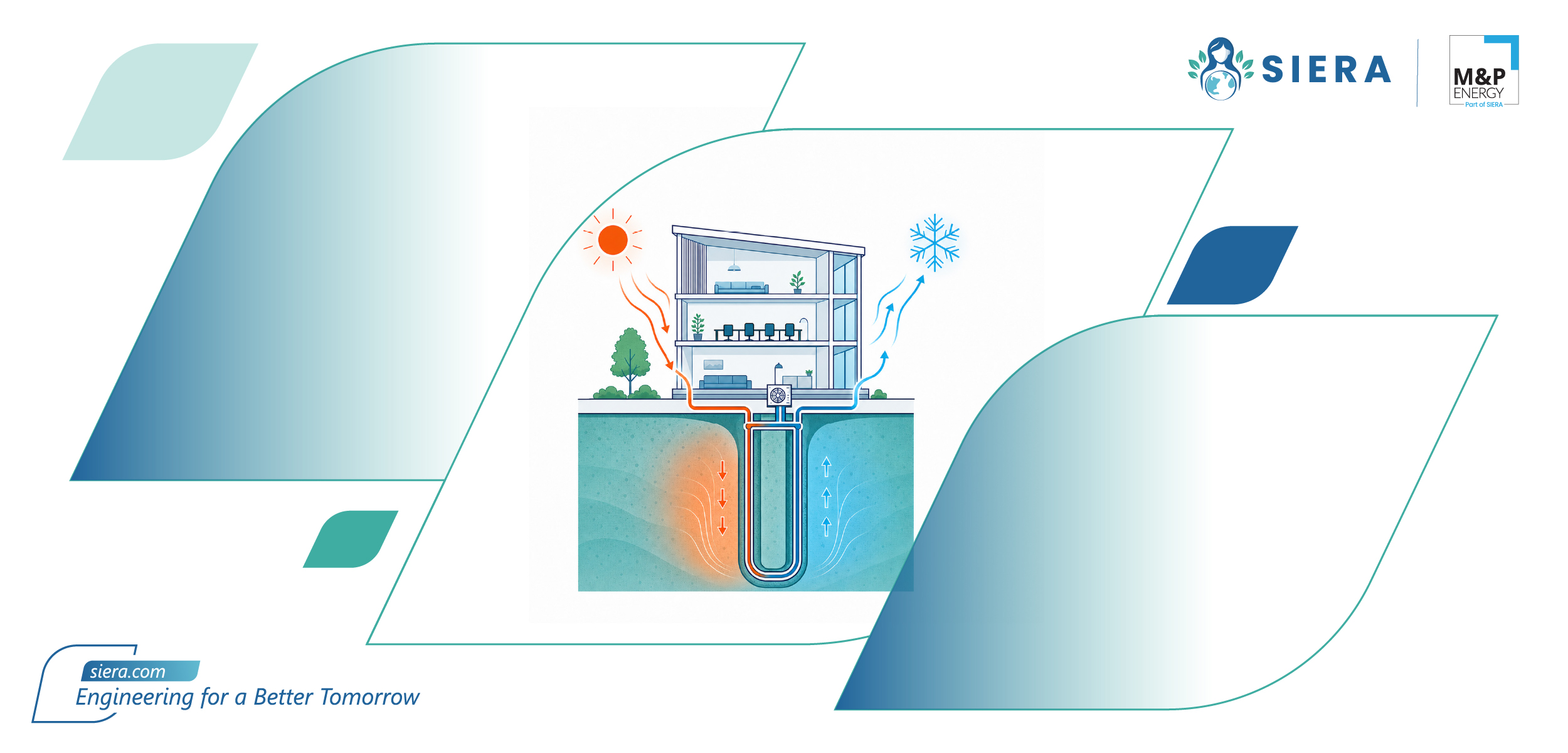
A heat pump transfers heat from one source to another location. In heating mode, it absorbs heat from the environment and supplies it to the building. In reversible mode, this cycle can be reversed: heat is extracted from the building and released to the outside or into the ground.
This form of cooling differs from air conditioning that is switched on for short periods. In many cases, it involves continuous, moderate temperature control within a building. It maintains the room temperature at a comfortable level, rather than cooling rooms down rapidly.
Several factors are essential for successful refrigeration:
| Prerequisite | Significance for building temperature control |
| Appropriate heat transfer | Underfloor heating, concrete core activation or cooling ceilings can absorb heat over a large area |
| Control and dew point monitoring | Prevents condensation from forming on cool surfaces |
| Appropriate building design | Shading, ventilation and insulation affect cooling requirements |
| Continuous operation | Inert surface systems are suitable for maintaining a uniform temperature |
| Professional design | The heat source, heat distribution and building load must be considered together |
Radiators are generally of limited suitability for cooling because their surface area is small and low flow temperatures can lead to condensation. Underfloor heating, concrete core activation and other surface-based systems, on the other hand, often offer better conditions, provided that the control system and dew point limits are taken into account.
Air-source heat pump or geothermal energy?
Air-source heat pumps can be a sensible option when used in cooling mode. However, their actual efficiency depends on the outdoor temperature, the desired room temperature, the heat transfer system used and the design of the system.
Geothermal systems make use of the relatively stable temperatures of the subsoil. At suitable depths, the subsoil temperature often remains within a range of around 10 to 15 °C throughout the year, depending on the location, geology and depth.
These stable conditions can offer an advantage in summer: whilst the outside air warms up significantly, the ground remains comparatively cool. This means that a ground-source heat pump can draw on a reliable source of energy both for heating in winter and for maintaining a comfortable temperature in the building during the summer.
Other potential benefits of geothermal systems include:
- no outdoor unit on the building
- Quiet operation, depending on the system configuration
- Using the cool ground to regulate the temperature inside buildings
- Integration of heating and cooling within a single system
- Opportunity for seasonal regeneration of the subsoil
Passive cooling: Making direct use of the ground
With appropriate planning, a geothermal system can also provide passive cooling in summer. This involves utilising the cooling effect of the ground via a heat exchanger and the circulation of the heat transfer fluid. In many cases, the heat pump’s energy-intensive compressor does not need to be operated for this purpose.
However, the system does not operate entirely without energy: electricity is still required for circulation pumps and control systems. Compared with active cooling, passive cooling can nevertheless be particularly energy-efficient.
Whether passive cooling is possible and advisable depends, amongst other things, on the geothermal system, the heat distribution within the building, the desired temperature control and the local conditions.
Cooling can help the subsoil to recover
The combination of heating and cooling offers a significant additional benefit in geothermal energy systems. In winter, heat is extracted from the ground to heat the building. In summer, the heat extracted from the building can be returned to the ground.
This process is known as active regeneration. It can help to balance the seasonal energy balance of a geothermal plant. A balanced, or as balanced as possible, energy balance supports the long-term performance of the system.
This may be relevant during the planning stage, as a building’s heating and cooling loads are considered together. A sensibly integrated cooling system can therefore, under suitable conditions, have a positive effect on the design of the ground-source system. However, the extent to which investment and operating costs can be reduced must always be assessed for the specific site and the building in question.
@M&P Energy within SIERA – views heating, cooling, the building envelope and the energy source as an integrated whole. This enables the development of solutions tailored to the actual requirements of a building and its use.
Emergency measures for hot days
Anyone who still has to get through the summer without a heat pump or building temperature control can reduce heat gain by taking a few simple measures:
- Keep the sun out
External shading is particularly effective. It prevents sunlight from entering the building through the windows and further heating up the interior.
- Ventilate at the right time
Windows should be opened when the outside temperature is lower than the room temperature – often early in the morning or in the evening and at night.
- Reduce internal heat sources
Electrical appliances, cooking and baking generate extra heat. Where possible, opting for cooler cooking methods or barbecuing outdoors can help to alleviate the heat.
These measures are no substitute for a long-term building strategy. However, they can help to reduce the strain on the building during hot days.
Planning heating and cooling together
Sustainable summer comfort is achieved through the interplay of several factors: a suitable building envelope, effective shading, well-designed ventilation, appropriate heat transfer and an energy supply that combines heating and cooling.
Heat pumps and geothermal energy can play an important role in this regard. Particularly in the case of new builds and major refurbishments, it is worth incorporating building temperature control into the planning at an early stage. This allows requirements relating to comfort, energy consumption and long-term use to be considered together.
M&P Energy together with SIERA supports the development of integrated concepts for heat supply, building temperature control and geothermal energy.
CTA
Are you planning to install a heat pump, carry out a refurbishment or build a new home? Find out how M&P Energy - Part of SIERA – can combine heating, cooling and geothermal energy within a site-specific energy strategy: M&P Energy
Engineering for a Better Tomorrow