 EN
 DE



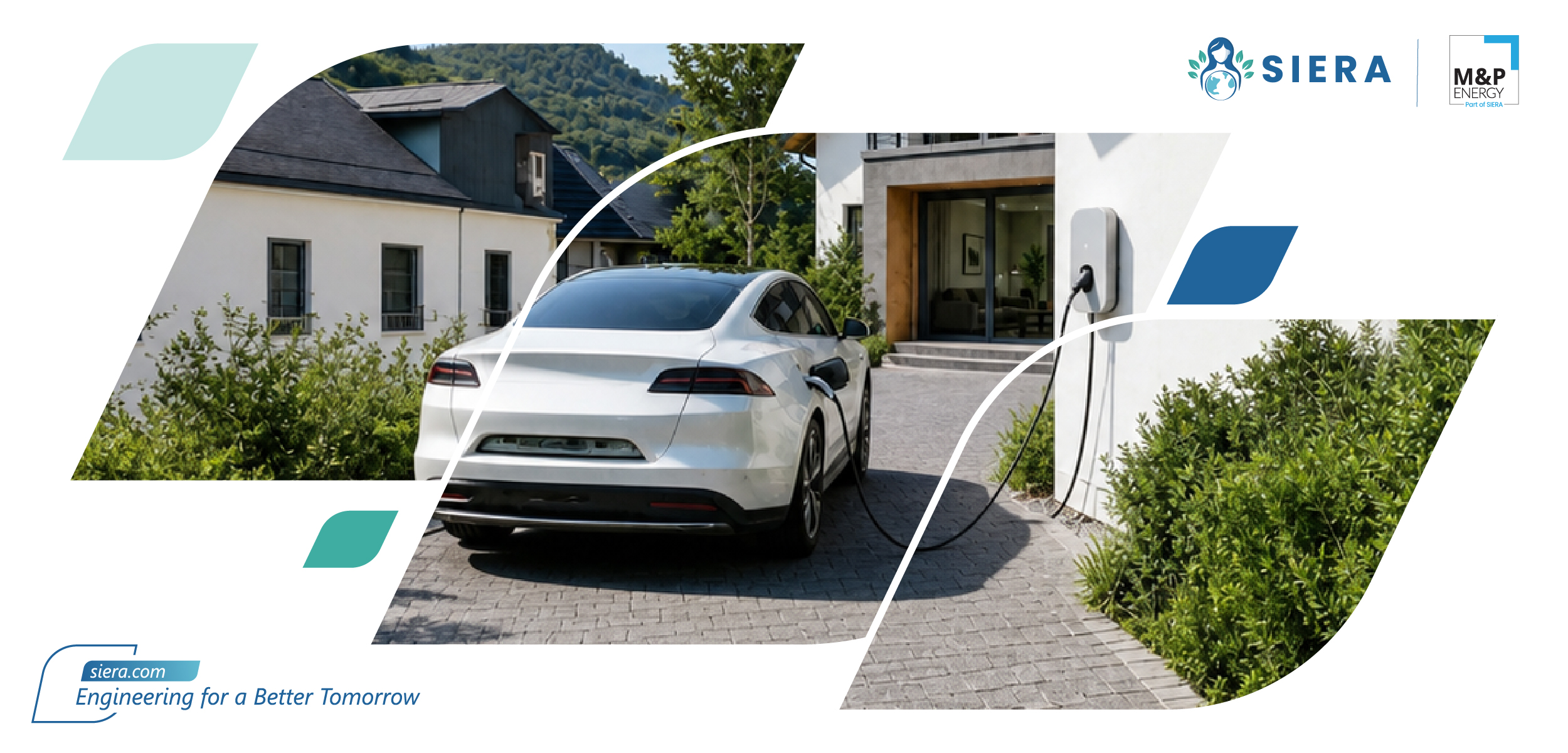
When a parked electric car becomes part of the energy supply
An electric car charges up so that you can drive it. When bidirectional charging The electricity can also flow in the opposite direction: from the vehicle’s battery back into a building or into the public grid. This raises a question that is becoming increasingly relevant for households and the energy system: Can a car still be of use even when it is not on the road?
The answer depends on the specific application. For example, a compatible vehicle can store solar power it has generated itself and make it available to the household at a later time. When feeding electricity into the grid, its battery can, under the right conditions, provide flexibility for the electricity system. Both of these scenarios require more than just a large battery: the vehicle, charging equipment, metering system, control system and contractual terms must all be compatible.
M&P Energy - Part of SIERA – therefore considers bidirectional charging in conjunction with the building, charging infrastructure and energy supply. Only a coordinated, holistic approach can deliver a solution that meets your needs.
What do ‘Vehicle-to-Home’ and ‘Vehicle-to-Grid’ mean?
With conventional charging, electricity flows into the car battery. Bidirectional charging adds the ability to feed energy back out in a controlled manner. Two applications are of particular interest:
| Application | Where does the electricity flow back to? | Potential benefits |
| Vehicle-to-Home (V2H) | Into one’s own home | Using stored electricity in the home at a later time |
| Vehicle-to-Grid (V2G) | Into the public electricity grid | Feed energy back into the grid in accordance with the terms of a suitable offer |
An example of V2H: Your solar panel system generates electricity during the day whilst your car is plugged in. Some of this can be stored in the car’s battery and used later in the house – if the vehicle and the entire V2H system.
V2G has a different objective. In this case, electricity is fed into the grid. This requires, amongst other things, a compatible service as well as appropriate metering and billing processes. V2H and V2G are therefore not automatically available with the same vehicle-wallbox combination.
A Emergency power supply You should not assume this: it is a standalone function and must be explicitly supported by the specific system.
A large battery does not in itself constitute a usable home energy storage system
Electric cars can have significantly larger batteries than typical stationary home storage systems. A comparison of around 60 to 80 kWh Vehicle capacity with a smaller home battery illustrates the potential. However, it does not yet indicate how much energy is actually available to your home.
A portion of the battery charge must remain available for the next journey. Added to this are potential limitations imposed by the vehicle and the charging equipment, as well as losses during charging and discharging. It is therefore not just the size of the battery that is decisive, but what usable capacity you wish to make available, when the car is plugged in, and how the system is controlled.
Good planning starts with your day-to-day life: When is the vehicle parked at home? When do you need electricity in the building? Do you have a solar panel system? And what is the minimum charge level you need to maintain at all times to ensure your mobility?
Why is that? Theme for 2026 is becoming increasingly important
The potential is huge, but it must not be confused with storage capacity that is already available. According to Federal Motor Transport Authority were on 1 January 2026: around 2.03 million fully electric cars registered in Germany. Not all of these vehicles are capable of bidirectional charging. Nevertheless, the figure illustrates why the link between electric mobility and the electricity supply is attracting increasing attention.
The regulatory framework is also evolving. On 1 October 2026 decided that the Federal Network Agency’s MiSpeL determination on the market integration of storage systems and charging points. It opens up new possibilities for incorporating bidirectional charging points into certain forms of grid injection.
That means not, that since 2026 any electric car can feed electricity into the grid without any further requirements. By the end of September 2027 A transitional period applies to the use of the options in question, during which the consent of the network operator and the metering point operator is required. Furthermore, state aid approval is still pending for one of the options. The specific requirements must be assessed for each individual project.
The first commercial V2G service – with clear terms and conditions
The following example shows what a practical offer might look like: The V2G solution from the BMW Group and E.ON, unveiled in February 2026. It is initially designed for compatible vehicles from BMW’s „New Class“ range and combines the vehicle, a bidirectional wallbox, an electricity tariff and other necessary components.
According to the published terms and conditions of the offer, when V2G is activated, a bonus of 24 cents per hour of work incurred – limited to 60 euros a month or 720 euros per year. In addition, the offer states 40 cents for every kilowatt-hour fed back into the grid. The amounts apply within the framework of this specific contract model and are no standard remuneration for bidirectional charging.
It is also important to distinguish between different tariff models: purchasing electricity when prices are low and feeding it back into the grid at a later time is one possible flexibility strategy. However, the BMW-E.ON V2G scheme mentioned above has a fixed unit price ; it should not be described across the board as a dynamic electricity tariff. Whether an offer is financially worthwhile depends on all the terms and conditions of the contract, the purchase and installation costs, and your usage patterns.
What you should consider before making a decision
Bidirectional charging is not a feature that can be retrofitted simply by installing a new wallbox. Before you invest, it is worth carrying out a thorough assessment:
- Vehicle: Does your specific model support V2H, V2G or both?
- Charging device: Has the wallbox been approved for the intended use?
- Buildings and connections: Are the domestic wiring, mains connection and, where applicable, the photovoltaic system suitable for the project?
- Measurement and control: How are current flows measured and how is the car’s minimum charge level maintained?
- Rate and contract: What are the actual remuneration, costs, terms and conditions of participation?
- Your everyday life: Is the vehicle connected at the times when you want to use the storage function?
For M&P Energy within SIERA The focus here is on ensuring the system is properly integrated into the wider energy system. The largest possible storage capacity is not automatically the best solution; what matters is whether the components work together reliably and whether your mobility needs are taken into account at all times.
From potential to the right application
Two-way charging can give electric cars an additional role: as a storage solution for the home or as a flexible resource for the electricity grid. The first commercial offerings and the further development of the regulations are making these possibilities more tangible. At the same time, compatibility, installation and cost-effectiveness remain issues that need to be addressed on a case-by-case basis.
By considering vehicles, buildings, photovoltaic systems and charging infrastructure together at an early stage, you can make a more informed decision about which solution is appropriate. M&P Energy together with SIERA focuses on this interplay – so that a promising idea can be turned into a well-thought-out energy concept.
Blog CTA
Would you use your car battery to power your home or feed electricity into the grid? If you’d like to look into bidirectional charging for your building, contacted M&P Energy - Part of SIERA. Discuss the requirements that your vehicle, your charging infrastructure and your energy supply must meet.
Engineering for a Better Tomorrow